Pressure:0.3-0.7Mpa
Temp:- 25°C~ 55°C
Explosion-proof class:CT6+Dust explosion protection
Design: Pilot diaphragm type
Flameproof head:Aluminum housing (or stainless steel housing)
Body: cast aluminum or (stainless steel)
power:19W
Cable interface:NPT1/2
Diaphragm life: more than 1 million blows
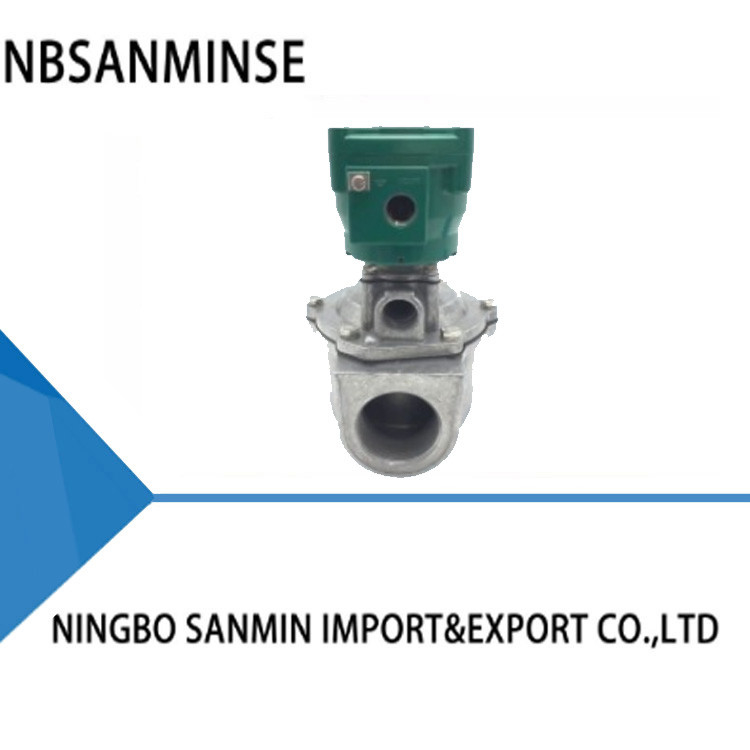
Explosion-proof pulse valve is an electromagnetic control valve specially designed for flammable and explosive environment. It is mainly used in industrial dust removal system and other scenes to prevent explosion risks by safely releasing pressure or controlling air flow
one
2. Its core functions include:
Pressure control and explosion-proof protection
Regulate the compressed air flow through the pulse opening and closing action to prevent explosion caused by pressure surge inside the dust collector
1. For example, an explosion-proof right-angle pulse valve can quickly respond to pressure changes to relieve pressure in a timely manner
1.
Wrap the electromagnetic coil with special resin material, completely isolate spark and explosive environment, and realize active explosion-proof
2.
Safety isolation of ignition source
Explosion-proof electromagnetic head is used to seal the power line by gluing to avoid looseness and sparks. It is applicable to the environment mixed with combustible gas or dust
2.
Comply with European directive 94/9/CE standard, with explosion-proof grade of Grade II to ensure stability under severe environment

Q: Could you offer the free samples ?
A: Yeah, but it depends products, Pls contact us ina@pneuhydr.com or whatsapp 0086 15168536055
Q: What ' s your business scope ?
A: Our business scope is service of exporter automation parts with full container, and sell air cylinder , air source treatment , solenoid valve , air valve, motorize valve , Brass valve, hydraulic valve, hydraulic cylinder, air and oil fitting, pressure gauge etc .
Q: What types of products you can make ?
A: We can make many kinds of stainless steel, brass ,aluminum materials processing .like high pressure Valve / solenoid valve / electric valve / water valve/pneumatic valve/air cylinder/hydraulic valve/hydraulic accumulator products and so on .
Q: Can the product be made with our logo and brand ?
A: Yes , of course , we can make . we are OEM supplier for years and professional to make . But you need give us the authorization if it is possible .
Q:Can you provide original famous pneumatic and hydraulic,instruments brand goods ?
A: Yes,We can supply like Festo,Smc,Ckd,Burket,Hydac,Rexroth,SMS,RSMT,Marsh ,Endress+Hauser etc.
Q: Is there a warranty available?
A: Yes, normally products is one year quality guarantee.
Q: Is the connector in British or Metric system? What is the difference between PT, NPT, and G threads?
A: The G thread is cylindrical and does not seal itself, requiring additional gaskets to prevent leakage. PT and NPT are conical, and the internal and external threads become tighter and tighter when tightened. Sealing is achieved through the deformation of the threads, and sealant or tape is usually used in conjunction to enhance the sealing effect
G-thread is a cylindrical straight pipe used for non sealed connections; PT thread is a conical tube that relies on the deformation and sealing of the thread itself; NPT is also a conical tube with a tooth profile angle of 60 degrees, mainly used in North America
Q: How to convert pressure units: MPa, bar, psi, kg/cm ²?
A: 1MPa=10bar≈145psi≈10kg
Q:What usually causes the burnout of solenoid valve coils?
A:Incorrect voltage and hz, frequent switching, pilot head entering liquid,valve core and spring problem,environment hot,heavy vibration etc.
Q: What should be noted for pneumatic components in high temperature or extremely cold environments?
| Focus Point |
High Temperature Environment Countermeasures |
Extreme Cold Environment Countermeasures |
| Seals |
Fluororubber, PTFE |
Low-temperature nitrile, silicone rubber, polyurethane |
| Lubrication |
High-temperature synthetic grease (low volatility) |
Low-temperature grease (low pour point, low viscosity) |
| Air Supply Treatment |
Strengthen cooling, efficient water removal |
Ultra-low dew point drying (refrigeration + adsorption type), heat tracing |
| Metal Components |
Reserve expansion clearance |
Select materials with low-temperature toughness, prevent leakage due to cold shrinkage |
| Control Components |
High heat-resistant grade coils, heat dissipation, low power consumption |
Install insulation boxes, local heating, prevent cold condensation |
| Installation |
Keep away from heat sources, add heat insulation plates |
Avoid exposure to wind and snow, wrap with thermal insulation materials |


 Your message must be between 20-3,000 characters!
 English